


Trebbiano Romagnolo
This variety is typical of, and intensely grown in Romagna. It perhaps originated in the eastern Mediterranean Basin; it is barely common in Emilia or any other Italian viticultural areas.
CULTIVATED AREA IN ITALY
|
YEAR |
1970 |
1982 |
1990 |
2000 |
2010 |
|
HECTARES |
26.992 | 25.828 | 28.908 | 20.020 | 16.656 |
Bud-burst period: everage.
Ripening period: everage.
Yield:abundant and constant; since the vine is very fertile, it is necessary to adopt a not excessively rich pruning, depending on the environment, in order not to jeopardize the final quality.
Ampelographic characters:
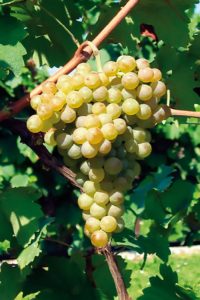
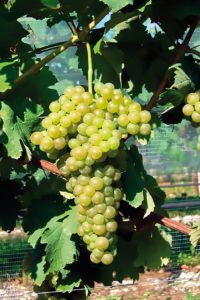
the variety is quite homogeneous, slight differences are found only in cluster shape and size, and in fertility. The bud has a medium expanded, cottony, whitish apex. The leaf is medium-sized, pentagonal, five- or three-lobed, with a cup-shaped flap, pale green, and a little bulbus, tomentose lower side. The petiolar sinus is lyre-shaped or closed V-shaped, with overlapping or closing edges. The cluster is medium-to-large, truncated-pyramidal, with two evident wings, and fairly compact. The berry is medium-sized, spheroid, amber-yellow in colour, quite easily detachable; the skin is thick; the pulp is juicy, acidulous and sweet.
Cultural aptitude:
vigorous vine with semi-drooping growth habit and medium-robust, long shoots. Suitable to different environments; if grown in hilly areas, it can give a product of a certain finesse.
Training system and pruning:
suitable to different systems of training, but it prefers long and rich pruning. It also accepts medium-short pruning; the plasticity of the shoots allows every form of mechanization of pruning.
Susceptibility to diseases and adverse conditions:
a little susceptible to powdery mildew, very susceptible to mites.
Enological potential:
it produces a wine of straw-yellow colour, with a winey aroma, clean and with a certain elegance especially if produced in hilly areas. Recommended also for sparkling wines, being provided with good fixed acidity, and for brandy production.
Clones in propagation:
Trebbiano Romagnolo R5, VCR424, VCR429, VCR436.
Trebbiano Romagnolo
R5
Enological potential:
Origin: Prati di Lugo (RA)
Registration year: 1969
VARIETY EVERAGE
SENSORY PROFILE
—●— Variety everage
—●— R5


Trebbiano Romagnolo
VCR424
Enological potential:
Origin: Durazzanino (FO)
Registration year: 2013
VARIETY EVERAGE
SENSORY PROFILE
—●— Variety everage
—●— VCR424

Trebbiano Romagnolo
VCR429
Enological potential:
Origin: Durazzanino (FO)
Registration year: 2013
VARIETY EVERAGE
SENSORY PROFILE
—●— Variety everage
—●— VCR429

Trebbiano Romagnolo
VCR436
Enological potential:
Origin: Durazzanino (FO)
Registration year: 2013
VARIETY EVERAGE
SENSORY PROFILE
—●— Variety everage
—●— VCR436
