


Garganega
Probably originated in Greece. The heart of its production is the Soave and Gambellara areas in Veneto. Grecanico, which is an almost identical vine variety, is prevalent in Sicily.
CULTIVATED AREA IN ITALY
|
YEAR |
1970 |
1982 |
1990 |
2000 |
2010 |
|
HECTARES |
13.799 | 12.484 | 13.048 | 11.636 | 10.253 |
Bud-burst period:everage-late.
Ripening period:everage-late.
Yield: abundant and constant; the number of buds per plant should not be excessive for a good lignification of the shoots and an even ripening of the grapes.
Ampelographic characters:
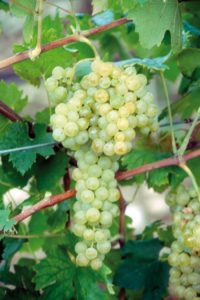
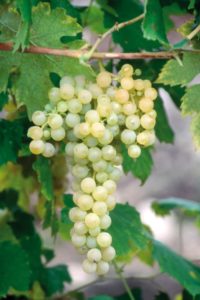
the variety is not very homogeneous, the main differences being not only the cluster but the general appearance of the plant as well. We will therefore examine the most widespread Garganega in the classic growing areas (Soave, Gambellara). The bud presents an averagely expanded whitish-green and cottony apex. The medium-sized, pentagonal, five-lobed leaves have evident teeth and a slightly blistered, glabrous and dull green blade. The V- or U-shaped petiolar sinus is more or less open. The underside is arachnoid. The long cylindrical cluster has very evident wings, is relatively sparse, and a rachis that sometimes splits at the tip. The berry is medium-sized, spheroid, golden-yellow, and tends to detach rather easily. The umbilicus is persistent. The thick skin has juicy flesh and simple flavour.
Cultural aptitude:
vigorous vine with a semi-upright growth habit. Long and averagely strong shoots, a little fragile, with medium internodes and poor lignification in colder climates. It prefers loose, fertile soils and a possibly good exposure in classic growing areas for a good quality product.
Training system and pruning:
it requires fairly expanded training systems and long pruning in northern climates; it however adapts well to medium pruning in southern regions. Classically grown using the “pergola” or “tendone” systems. It does not adapt well to extensive
mechanisation in northern regions. In warmer southern climates, where the vine shoots ripen well, the vines can be trained with a counter-espalier system, which is easily mechanisable.
Susceptibility to diseases and adverse conditions:
susceptible to flavescence dorée, rachis desiccation and iron chlorosis. Incompatibility has been observed when using Kober 5BB as a rootstock.
Enological potential:
it produces a straw-yellow wine with golden highlights, slender in body, fresh, rightly tannic and acidic, fragrant. With an adequate storing in a fruit cellar it makes an excellent Vinsanto.
Clones in propagation:
Garganega R4, VCR7, VCR13, VCR39, VCR105, ISVCV11, ISVCV18, ISVCV24, ISVCV69, ISVCV84.

Garganega
R4
Enological potential:
Origin: Gambellara (VI)
Registration year: 1969
VARIETY EVERAGE
SENSORY PROFILE
—●— Variety everage
—●— R4


Garganega
VCR7
Enological potential:
Origin: Gambellara (VI)
Registration year: 2006
VARIETY EVERAGE
SENSORY PROFILE
—●— Variety everage
—●— VCR7


Garganega
VCR13
Enological potential:
Origin: Soave (VR)
Registration year: 2006
VARIETY EVERAGE
SENSORY PROFILE
—●— Variety everage
—●— VCR13

Garganega
VCR39
Enological potential:
Origin: Soave (VR)
Registration year: 2006
VARIETY EVERAGE
SENSORY PROFILE
—●— Variety everage
—●— VCR39

Garganega
VCR105
Enological potential:
Origin: Gambellara (VI)
Registration year: 2006
VARIETY EVERAGE
SENSORY PROFILE
—●— Variety everage
—●— VCR105
