Chardonnay
A French variety originally cultivated in the Champagne and Burgundy regions. It is widespread in all the various wine-growing regions of the world. According to OIV estimates, in 2000 the Chardonnay accounted for 100,000 ha of the vineyards worldwide.
CULTIVATED AREA IN ITALY
|
YEAR |
1970* |
1982* |
1990 |
2000 |
2010 |
|
HECTARES |
-* | 172* | 6.180 | 11.773 | 24.095 |
* see Pinot Blanc
CULTIVATED AREA IN FRANCE
|
YEAR |
1968 | 1979 | 1988 | 1998 | 2008 | 2018 |
|
HECTARES |
9.805 | 13.042 | 19.869 | 33.070 | 42.017 | 54.993 |
Bud burst period: early.
Ripening period: early.
Yield: average and constant with every training system: it can become abundant with heavy, intense pruning, thus however compromising the quality of the product.
Ampelographic characters:
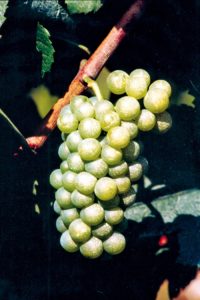
this variety is quite homogeneous, although with substantial differences related to productivity and organoleptic properties of the grape. The bud has a yellowish-green expanded apex, which is slightly tomentose. The medium-sized, roundish leaf is almost whole, with a slightly bulbous upper surface and a dark green color. It is sparsely tomentose. The U-shaped petiolar sinus has open ribs delimiting the bottom at the petiolar point. The medium-sized cluster, fairly compact, has a truncated cone shape and an evident wing. The berry is medium-sized, and golden-yellow. The skin is of medium thickness.
Cultural aptitudes:
this vigorous variety, gifted with solid shoots with a short internode and an upright growth habit, is generally balanced. It is adaptable to various soil types and climates, provided they are not too humid. Cultivation in overly dry areas should be avoided.
Training system and pruning:
suitable to different forms of training, even to completely mechanised ones, and to different planting layouts, provided they are not too tight. It can be pruned short in the south or medium-to-long in northern areas, to ensure a balanced bud load across the plant. In more humid northerly climate, an adequate green pruning is necessary, in order to get a regular ripening of the grapes and to avoid the onset of botrytis and sour rot.
Susceptibility to diseases and adverse conditions:
average, although in humid years and in northern areas it is slightly more susceptible to botrytis. Susceptible to phytoplasma diseases of the vine. Extremely resistant to chlorosis and highly susceptible to late frosts. In specific climate conditions, incompatibility with 3309cC and Gravesac may be observed.
Enological potential:
it produces a wine with a typically varietal flavour, straw-yellow in colour, with golden reflections and delicate scents. Full-bodied, pleasantly acidic and with a good alcohol content. Excellent as a sparkling wine base. When vinified as a white wine, it takes on a straw-yellow colour. Its usage in blending brings interesting improvements of other wines which are typically neutral.
Clones in propagation:
Chardonnay R8, VCR4, VCR6, VCR10, VCR11, VCR179, VCR399, VCR434,VCR481, VCR484, ISV1, ISV4, ISV5, SMA108, SMA123, SMA127, SMA130, ISMA105, STWA95-350, STWA95-355; cloni francesi: Inra-Entav 75, 76, 78, 95, 96, 117, 121, 132, 277, 548, 809.

Chardonnay
R8
Enological potential:
Origin: San Michele all’Adige (TN)
Registration year: 1969
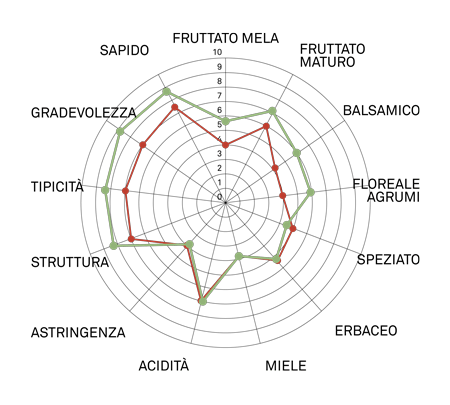
VARIETY EVERAGE
SENSORY PROFILE
—●— Variety everage
—●— R8


Chardonnay
VCR4
Enological potential:
Origin: San Michele all’Adige (TN)
Registration year: 1995
VARIETY EVERAGE
SENSORY PROFILE
—●— Variety everage
—●— VCR4


Chardonnay
VCR6
Enological potential:
Origin: California
Regisration year: 2003
VARIETY EVERAGE
SENSORY PROFILE
—●— Variety everage
—●— VCR6


Chardonnay
VCR10
Enological potential:
Origin: Grave di Rauscedo (PN)
Registration year: 1995
VARIETY EVERAGE
SENSORY PROFILE
—●— Variety everage
—●— VCR10

Chardonnay
VCR11
Enological potential:
Origin: California
Regisration year: 2003
VARIETY EVERAGE
SENSORY PROFILE
—●— Variety everage
—●— VCR11


Chardonnay
VCR481
Enological potential:
Origin: Tauriano (PN)
Registration year: 2014
VARIETY EVERAGE
SENSORY PROFILE
—●— Variety everage
—●— VCR481

Chardonnay
VCR484
Enological potential:
Origin: Tauriano (PN)
Registration year: 2014
VARIETY EVERAGE
SENSORY PROFILE
—●— Variety everage
—●— VCR484