


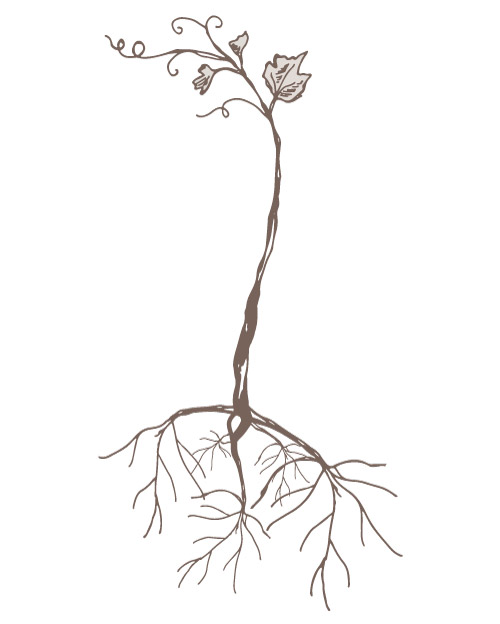
31 Richter x Blanchard 1B
Fercal
Origin: France (R. Pouget – INRA Bordeaux – 1959).
VEGETATIVE FEATURES
Leaf: medium-to-large, wedge-shaped, whole, with a large U-V shaped petiolar sinus; the upper side is hairless, bullous, arachnoid, the lower side is bristly, with a green-colored flap, cup-shaped, convoluted, thick.
Woody shoot: long, uniform, branched, with a prominent development of secondary shoots, ribbed, striated, arachnoid, gray-brown colored; it is prone to form bark fissures like 1103 P.
CULTURAL APTITUDES
Ability to promote fruit setting:
excellent
Root system regeneration:
good
Adaptability to soil type:
- compact: good
- wet: acceptable
- dry: good
- stony: good
- acidic: acceptable
- saline: sensitive
- calcareous: excellent
- superficial: poor
Branching pattern of the roots:
expanded
Tendency to emission of suckers:
poor
Susceptibility to deficiencies or excesses:
- deficiency of K: sensitive
- deficiency of Mg: very sensitive
- deficiency of Zn: sensitive
- deficiency of P: senstive
- deficiency of Mn: sensitive
- deficiency of Fe: low sensitivity
Resistance to root phylloxera:
high
Resistance to leaf phylloxera:
good
Susceptibility to fungal and plant diseases:
downy mildew: sensitive
powdery mildew: sensitive
botrytis: sensitive
anthracnose: low
eutypa disease: it induces sensitivity
rachis desiccation: it induces sensitivity
phomopsis cane and leaf spot: sensitive
esca disease: very sensitive
OTHER INFORMATION