


Negro Amaro
Probably introduced by the Greeks in the Ionian arc, it is most widespread in the provinces of Lecce, Brindisi and Taranto.
CULTIVATED AREA IN ITALY
|
YEAR |
1970 |
1982 |
1990 |
2000 |
2010 |
|
HECTARES |
42.350 |
38.421 | 31.387 | 16.759 | 19.780 |
Budbreak period: medium.
Ripening period: medium.
Yield: abundant and consistent in all training systems.
Ampelographic characters:
this variety is rather homogeneous, the different features of the cluster often depend on the different training systems, although there is a more or less a marked tendency towards green millerandage in the various biotypes. The expanded, cottony apex, has a whitish-yellow colour and vinous edges. The leaves are large, five-lobed, with prominent and overlapping upper lobes. The leaf blade is thick, cupped, wrinkled and slightly velvety on the underside. The petiolar sinus is narrow and V-shaped. The cluster is medium, tight, conical or truncated-conical. The medium-large, somewhat ovoidal berry, has a visible umbilicus, as well as a pruinose, thick and consistent skin. The juicy flesh has a simple, sweet taste.
Cultural aptitudes:
very vigorous vine with an upright growth habit and robust shoots with medium internodes. It adapts to different soils and to warm, even dry climates.
Training system and pruning:
it adapts to different training systems, depending on the possibility of irrigation, and to short or long pruning, from gobelet to “tendone”, and to training systems which allow a full mechanisation.
Susceptibility to diseases and adverse conditions:
normal, slightly susceptible to botrytis during rainy autumns. It shows disaffinity on rootstock 101.14.
Enological potential:
it produces a wine of an intense garnet-red colour, which is full, slightly bitter, and round. It can make an excellent blending wine. When vinified in rosé with Malvasia Nera, it gives an excellent, fine, lively, fruity wine with a delicate scent.
Clones in propagation:
Negro Amaro VCR10, VCR123, VCR449, VCR468, VCR469, ISVSNCLE56, ISVSNCLE64, ISVSNCLE71, CRSAD18, CRSAD23.

Negro Amaro
VCR10
Enological potential:
Origin: Cutrofiano (LE)
Year of approval: 1995
VARIETY EVERAGE
SENSORY PROFILE
—●— Variety everage
—●— VCR10

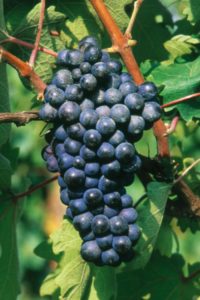
Negro Amaro
VCR123
Enological potential:
Origin: Lizzano (TA)
Year of approval: 2007
VARIETY EVERAGE
SENSORY PROFILE
—●— Variety everage
—●— VCR123
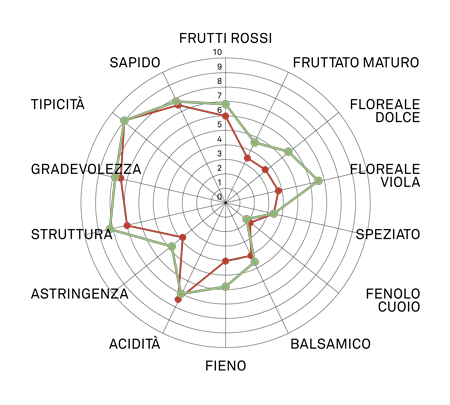

Negro Amaro
VCR449
Enological potential:
Origin: Lizzano (TA)
Year of approval: 2013
VARIETY EVERAGE
SENSORY PROFILE
—●— Variety everage
—●— VCR449


Negro Amaro
VCR468
Enological potential:
Origin: Lizzano (TA)
Year of approval: 2013
VARIETY EVERAGE
SENSORY PROFILE
—●— Variety everage
—●— VCR468


Negro Amaro
VCR469
Enological potential:
Origin: Lizzano (TA)
Year of approval: 2013
VARIETY EVERAGE
SENSORY PROFILE
—●— Variety everage
—●— VCR469
