Montepulciano
This vine has widely spread in the Abruzzo region and along the Italian side of the Adriatic coast.
CULTIVATED AREA IN ITALY
|
YEAR |
1970 |
1982 |
1990 |
2000 |
2010 |
|
HECTARES |
26.251 | 34.646 | 31.008 | 29.827 | 36.998 |
Budbreak period: late.
Ripening period: medium-late.
Production: medium-good and fairly consistent in both short and medium-long pruning systems.
Ampelographic characters:
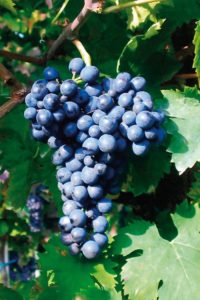
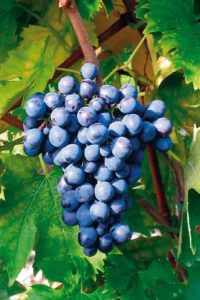
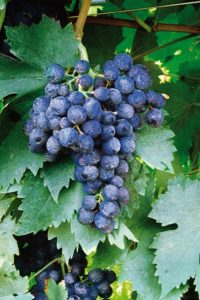
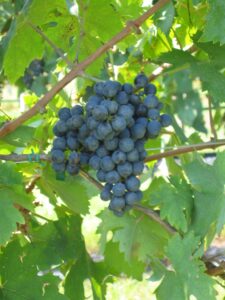
the variety is fairly homogeneous, the main differences being the cluster shape, the presence of green millerandage, the ripening period and the organoleptic properties of the product. The bud has an expanded, cottony apex, tomentose on the underside. The leaves are flat, medium-sized, pentagonal, five-lobed, of a deep dark green colour, tomentose on the underside. The cluster is medium-sized, more or less compact, cylindrical-conical, often winged. The medium, sub-oval, black-purple berry is not easy to detach. The skin is thick and pruinose, the flesh is juicy, slightly pinkish in color and has a simple flavour.
Cultural aptitudes:
vine of medium-to-good vigour, with a semi-upright growth habit. Medium shoots, rather short internodes and balanced vegetation. It prefers medium-textured deep, argillaceous, calcareous soils that are well exposed particularly in the northernmost growing areas. It needs warm, dry climates for a regular grape ripening.
Training system and pruning:
it requires not-too-expansive training systems and medium-short pruning. It adapts to full mechanization, provided certain environmental conditions are fulfilled, especially in the northernmost parts of the growing area.
Susceptibility to diseases and adverse conditions:
slightly susceptible to powdery mildew. Susceptible to green millerandage. Good resistance to late frosts.
Enological potential:
it produces wines of an intense ruby red color, with a distinctive winey scent, with a dry, fruity, tannic, not acidic taste. Full-bodied, velvety and fairly alcoholic. Vinification in white produces an excellent, savory, fruity and very agreeable rosé wine.
Clones in propagation:
Montepulciano R7, VCR100, VCR 419, VCR453, VCR454, VCR456, VCR462, VCR496, VCR498, APMP1, APMP3, UBARAMP11, UBARAMP12, UBARAMP13, UBARAMP14.
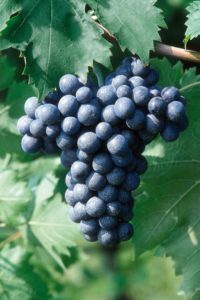
Montepulciano
R7
Teramano biotype
Enological potential:
Origin: Teramo
Year of approval: 1969
VARIETY EVERAGE
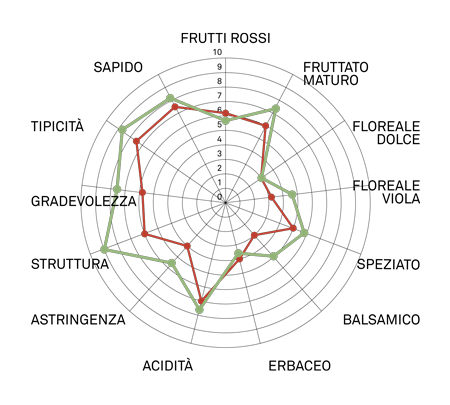
SENSORY PROFILE
—●— Variety everage
—●— R7


Montepulciano
VCR100
Chietino biotype
Enological potential:
Origin: Vacri (CH)
Year of approval: 2002
VARIETY EVERAGE
SENSORY PROFILE
—●— Variety everage
—●— VCR100
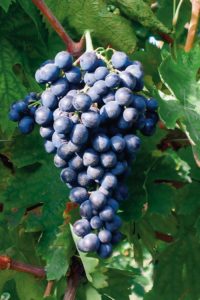
Montepulciano
VCR453
Vastese biotype
Enological potential:
Origin: Scerni (CH)
Year of approval: 2007
VARIETY EVERAGE
SENSORY PROFILE
—●— Variety everage
—●— VCR453

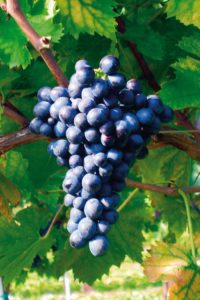
Montepulciano
VCR454
Vastese biotype
Enological potential:
Origin: Scerni (CH)
Year of approval: 2007
VARIETY EVERAGE
SENSORY PROFILE
—●— Variety everage
—●— VCR454

Montepulciano
VCR456
Casauria biotype
Enological potential:
Origin: Torre de’ Passeri (PE)
Year of approval: 2007
VARIETY EVERAGE
SENSORY PROFILE
—●— Variety everage
—●— VCR456

Montepulciano
VCR462
Peligno biotype
Enological potential:
Origin: Vittorio (AQ)
Year of approval: 2007
VARIETY EVERAGE
SENSORY PROFILE
—●— Variety everage
—●— VCR462


Montepulciano
VCR496
Frentano biotype
Enological potential:
Origin: Santa Maria Imbaro (CH)
Year of approval: 2009
VARIETY EVERAGE
SENSORY PROFILE
—●— Variety everage
—●— VCR496

Montepulciano
VCR498
Frentano biotype
Enological potential:
Origin: Santa Maria Imbaro (CH)
Year of approval: 2009
VARIETY EVERAGE
SENSORY PROFILE
—●— Variety everage
—●— VCR498

Montepulciano
VCR419
Enological potential:
Origin: Ancona (AN)
Year of approval: 2013
VARIETY EVERAGE
SENSORY PROFILE
—●— Variety everage
—●— VCR419